What to Call a Baby Born in Space
Imagine Giving Birth in Space
A start-up wants a adult female to evangelize a child 250 miles above Earth. The beginning question: Why?
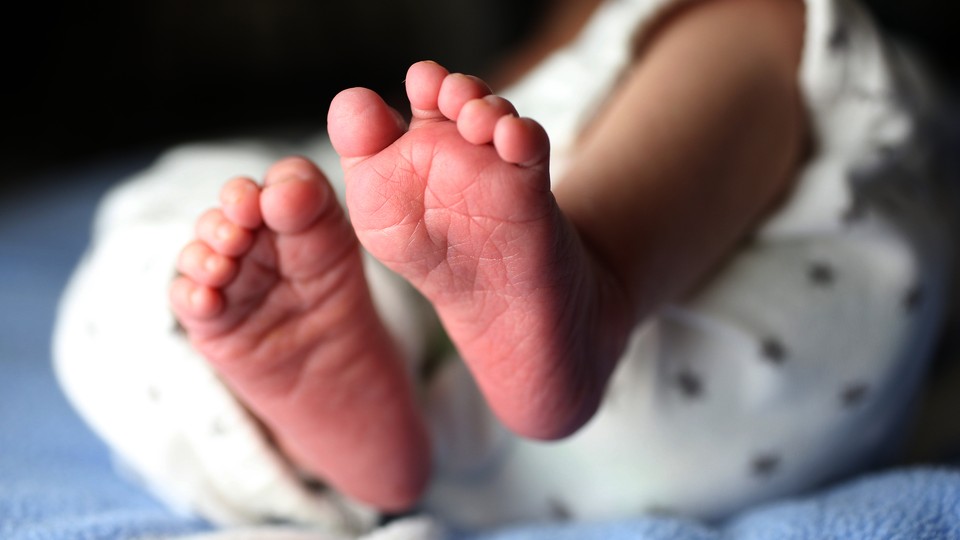
The moment has arrived at last. A adult female in a hospital gown steels herself, set up to push. A nearby monitor displays her babe'south heart charge per unit in large, neon numbers. A nurse in crisp scrubs coos in her ear, offering words of encouragement, communication. The scene would resemble whatever other delivery room if it weren't for the view exterior the window: the soft curvature of the blue Earth against the black of infinite, 250 miles below.
Delivering a child in microgravity may sound like science fiction. But for one start-up, it's the future.
SpaceLife Origin, based in the Netherlands, wants to send a pregnant woman, accompanied by a "trained, world-class medical team," in a capsule to the space above Earth. The mission would last 24 to 36 hours. Once the adult female delivered the child, the capsule would return to the ground. "A carefully prepared and monitored process will reduce all possible risks, similar to Western standards as they exist on Earth for both mother and child," SpaceLife Origin's website states. The company has ready the year 2024 every bit the target engagement for the trip.
The concept raises a host of questions—we'll go to those subsequently—simply mayhap the most firsthand may be this: Why?
Egbert Edelbroek, one of the visitor's executives, says spacefaring childbirth is role of creating an insurance policy for the human being species. Should a ending someday render Earth unlivable—climate change, Edelbroek suspects—he hopes the human species volition motility off-globe and settle elsewhere. Wherever they land, they will plant roots, build homes, and kickoff families.
"Human being settlements outside of Earth would exist pretty pointless without learning how to reproduce in infinite," Edelbroek says.
Off-white enough. If human being beings someday venture far beyond this planet and state on another—not to visit merely to stay—it's not incommunicable to imagine that a pregnancy could occur during the journey or on the footing. One tin pic toddlers in puffy spacesuits running effectually on Mars, the oxygen packs on their backs rattling with each bound.
Of course, this future assumes that man beings have resolved many other challenges that come with traveling to other worlds. Scientists are still trying to figure out how to keep adult humans healthy during long stays on the International Space Station, which is indeed in space, merely withal inside Earth'south magnetic field, an invisible bubble that protects the station and its inhabitants from the worst of infinite radiation. On superlative of that, the technology for deep-space travel doesn't exist. Human beings are a long way from condign an interplanetary species, and reproduction is just ane rung on a very alpine ladder.
Edelbroek says he has met with private spaceflight companies that may exist willing to launch the commitment mission, and with people who will pay for it. He's visited survivalist communities in the United States; he believes "preppers" are more likely to appreciate the company'due south ethos, and some are quite wealthy, spending thousands of dollars on loftier-finish shelters. He's even chatted with some women who are interested in claiming the historic title, for themselves and their offspring.
Allow'south say Edelbroek gets all three: money, a rocket, and a volunteer. What happens so?
Long before anyone gets off the ground, SpaceLife Origin will face a avalanche of questions from regulatory authorities, perhaps fifty-fifty from more than one nation. Commercial space travel is non confined past national borders, and it's not uncommon for customers in 1 state to pay the regime of some other to launch their payloads. SpaceLife Origin's ambitious mission could include an American woman, in a Japanese capsule, on an Indian rocket, accompanied by a team of doctors from multiple nations.
In this scenario, it's hard to say who will regulate what. The pregnant adult female's actions may be subject field to regulation, too. In the United States, women are harassed and fifty-fifty arrested for leaving their kids unattended, shamed for apparently putting immature children in danger. Infinite is far more than dangerous than the sidewalk outside a store. Would the law consider a woman's conclusion to give nascency in that location a criminal act?
Even if SpaceLife Origin finds a willing participant—and Edelbroek stresses that she will be calling the shots—would it be ethical for the visitor to send her? The doctors who would supposedly back-trail her, too, might risk violating the physician's adjuration: "First, practise no damage." Information technology seems difficult to brand the instance that helping launch a meaning woman into space follows this hope.
"Nigh of the pregnant women I know experience groovy condolement in knowing that they have access to medical help if in that location'southward an issue during a delivery—or prior to a delivery, or after a delivery," says Virginia Wotring, a professor of space medicine at Baylor College of Medicine. "Putting people in a situation where they are many, many, many miles away from medical assistance does not seem to exist advisable."
Allow's set aside, for a moment, the question of how SpaceLife volition fourth dimension labor contractions with a rocket launch to go their participant into space just in time for delivery. Astronauts usually experience iii times the strength of gravity during the ascent to orbit. In the case of a botched launch and emergency landing, that strength triples. It'due south unclear what outcome such farthermost pressure level could accept on a meaning person.
There's little in the literature to guide u.s. on what may transpire in orbit. Experiments on reproduction take been conducted in space, but they have been limited to mice, fish, lizards, and invertebrates. In the 1990s, meaning rats gave nativity after a calendar week on a U.Due south. space-shuttle mission. Each rat pup was born with an underdeveloped vestibular system, the inner-ear structure that allows mammals to residuum and orient themselves. Every bit scientists suspected, the absence of gravity had thrown the pups off-kilter. The animals' sense of residuum recovered non long later on nativity, but the lesson was clear: Animal infants need gravity.
Imagine childbirth without it. The expectant woman would be unable to accept walks to ease the pain of labor, to take reward of gravity'southward downward tug equally she pushed. The thought of administering an epidural seems terrifying; the anesthesiologist would accept to make sure her patient didn't float away as she carefully weaved a needle toward the spinal cord. Actual fluids would clump into blobs and glide through the capsule.
When the time came, the baby'south first breaths would suck in the air of a sealed metallic box, equanimous of oxygen made by complex artificial systems, not establish life. "A babe might be breathing a gas mixture that is unlike from Earth air," Wotring said. "Developed humans seem to handle it merely fine, but if y'all're using your lungs for the very first time, would it make a deviation? I don't know."
After the delivery is over, mom and infant would take to survive the descent back to Earth. For electric current astronauts, that involves a bone-rattling free fall through the atmosphere, followed by a parachute landing in the Kazakh desert. On the footing, the squad would be faced with nonetheless some other unusual question: Where do you get a birth certificate for someone built-in in space?
The listing of unknowns goes on and on. SpaceLife Origin seems similar an unusual player in such a perilous endeavor. The acme three employees named on the company'due south website are business executives with no experience in medicine or spaceflight, including Edelbroek, whose biography describes him as a "serial entrepreneur." Five advisers are listed, ii of them women. (Edelbroek says the company is working with dozens more than, simply declined to proper name them.) Edelbroek says his interest stems in office from his feel as a sperm donor, which led him to begetter several children and learn well-nigh in vitro fertilization techniques. Another of SpaceLife Origin's missions involves launching sperm and egg cells into space to grade an embryo and returning it to World for implantation.
Gerrit-Jan Zwenne, one of SpaceLife Origin's advisers and Edelbroek's cousin, is convinced that if this company doesn't do it, another will. Zwenne, a police professor at Leiden University, cited the case of He Jiankui, the Chinese scientist who appear in belatedly November, to the world's surprise, the alleged nativity of healthy twins whose embryos he had altered with a gene-editing technique known as CRISPR. The news prompted international outcry. His work, conducted in most-secrecy, flouted conventional norms in gene-editing technology, a fast-moving field that has avoided attempts at modifying human embryonic cells.
"I think at some point this will happen anyhow, and then nosotros better practice information technology in a very open and transparent manner," Zwenne says. "If it's somebody working on his own, in isolation, not in contact with the rest of the world, you may find that something happens and you lot can't reverse it."
Source: https://www.theatlantic.com/science/archive/2019/01/space-childbirth-babies/579064/
0 Response to "What to Call a Baby Born in Space"
Post a Comment